This piece was originally published in the Fall 2025 Edition of the NAFOA Navigator.
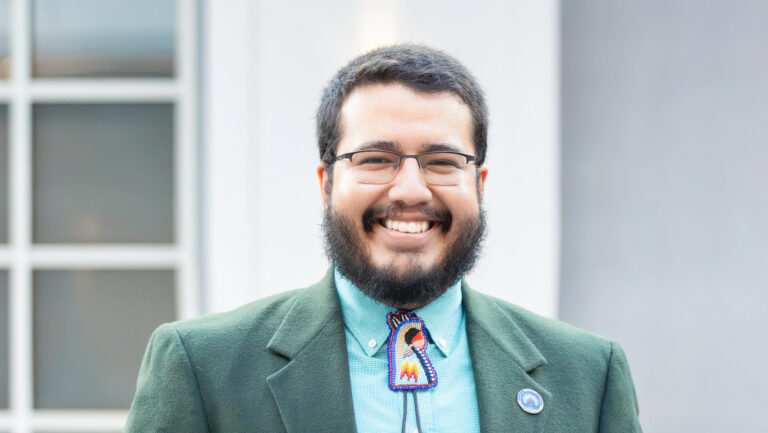
Jessica Bradby (Pamunkey Indian Tribe) is part of the second class of NAFOA Leadership Summit (2018) and a founding member of NAFOA’s Summit Alumni Committee. Before her Tribe achieved federal acknowledgment, Bradby had limited access to resources and networks that could satisfy her curiosity about Tribal affairs and community development. When Pamunkey gained federal recognition in 2016, Bradby took advantage of every opportunity to learn how her Tribe could leverage its status and assert its sovereignty toward the betterment of her community. This exploration led Bradby to NAFOA, where she began cultivating a flourishing professional network that is already positively impacting her career trajectory and professional contributions to her Tribe.
In this Q&A, Bradby shares how curiosity as a core principle is guiding her to design networks and services that transform her community.
On Her Background & Path to Working for Her Tribe
NAFOA: Could you introduce yourself and tell me about your work with your Tribe?
Bradby: I’m Jessica Bradby, and I’m a Pamunkey citizen. I serve as the very first Enrollment and Citizen Services Manager for the Tribe. Citizen services began as an information and referral service but has expanded to include elder care, food programs, and scholarships. This year, I’m focusing on developing programs for elders and youth.
NAFOA: Are there other titles or roles you hold?
Bradby: Yes. I sit on the board for the Virginia Native Arts Alliance, an intertribal group that supports Native artists by organizing markets and building relationships with art institutions. The group started with Pamunkey’s two-year grant from the Association of Tribal Archives, Libraries, and Museums, aimed at strengthening support for artists and knowledge holders by conducting needs assessments and determining priorities. When the grant ended, our executive director kept it going and made it open to all Native artists in Virginia. We work with institutions like the Virginia Museum of Fine Arts and the Chrysler Museum by connecting them with Native artists for exhibitions, events, education, and outreach. We’re hosting our first festival this year at Lewis Ginter Botanical Gardens in Richmond. I’m also on our Tribe’s NAGPRA committee, working with our cultural resources department to support Section 106 consultation reviews.
NAFOA: Are you also an artist?
Bradby: I enjoy woodburning as a creative outlet. A few years ago, I sold my art at local markets, and the pressure to create for sales stifled my creativity. Even though I don’t produce as much, I still see myself as an artist in how I perceive the world and my inherent creativity.
NAFOA: So what got you interested in Tribal affairs?
Bradby: Growing up, I felt a big disconnect between my Tribal identity and the lack of education about Native peoples in my schooling. This was true all the way through high school and into college, where my “American Political Thought and Practice” class completely overlooked Native perspectives, even when discussing the massacres of America’s founding. When I brought this up to a professor, his dismissive response motivated me even more to seek this knowledge myself.
At the time, my Tribe wasn’t federally recognized, and there wasn’t a lot of capacity for youth development or learning about Tribal governance. Since we weren’t federally recognized, I wasn’t eligible to apply for many of the opportunities that would have taught me what I wanted to know.
But when we gained recognition in 2016, a whole new world of opportunities opened up. Federal recognition was the key that unlocked access to resources, but it also raised the questions: What now? How do we leverage this? How do we build these programs and assert our sovereignty? I was eager to learn everything about Tribal governance, federal Indian law, and how to build our Tribal capacity. I started saying yes to every training and opportunity, which led me to my work at the Tribal office and eventually to NAFOA.
On Discovering and Engaging with NAFOA
NAFOA: What brought you to the NAFOA Leadership Summit?
Bradby: It was one of the first opportunities I was eligible for after recognition. I saw it and was immediately excited. Pamunkey was having early conversations about economic development, like a casino, but I wondered, What else can we do? I went into the Summit open, ready to be a sponge and soak up all the information I could. I had never been in a room like that with such established, knowledgeable people. I took notes on everything and everyone.
NAFOA: What did you gain from the Leadership Summit?
Bradby: My goal was to learn about economic development and how newly recognized Tribes can leverage their status. More than that, it was about the confidence it gave me. Being in that room, having leaders take the time to teach and listen, reinforced that I deserved a seat at the table. It gave me the confidence to speak up in other rooms and share my perspective.
On the Value of the NAFOA Network & Mentorship
NAFOA: Has the NAFOA network changed how you do your work?
Bradby: Absolutely. Watching how people advocate for their Tribes and organize around policy was incredibly powerful. It taught me how to be a more effective advocate. The network itself is a huge resource. For example, through an alumni email from NAFOA about an Allspring mentorship program, I was paired with a mentor who helped me apply for and get into the Native Nations Institute’s Tribal Professionals Cohort. It’s all connected—that’s the power of the network.
On the NAFOA Alumni Committee & Building Community
NAFOA: As a member of the first alumni committee, what was most important in shaping it?
Bradby: The goal is to leverage this incredible network. We all have this common experience and are in similar lines of work. We’re exploring how to create a channel for communication to share job opportunities, resources, and support. It’s a peer professional network where you can call someone and say, “I’m working on this thing. What do you know?” We’re still figuring it out, but the goal is to maintain the value of the network so that people stay engaged and take advantage of it.
On Her Current Role & Vision for the Future
NAFOA: What is your favorite part of your job now?
Bradby: I get to engage with citizens constantly and connect them to tangible resources. One minute I’m helping install bed rails for an elder, the next I’m working on policy, or a community health assessment. Every day is different, but all of it is built around serving my people. It’s humbling. I get to create the kind of support system I wished we had when I was younger.
NAFOA: What changes are you seeing in Tribal youth engagement, and how are you working to develop future leaders?
Bradby: I’m currently building our Tribe’s first youth engagement department. We’re looking to hire interns to expose young people to Tribal operations, and I’d love to create a youth committee for student input. My goal is to build comprehensive support systems by connecting youth to existing programs like language, arts, and natural resources, ensuring our programs are truly citizen-led and meet community needs.
NAFOA: What are you most excited to work on next?
Bradby: We’re hiring a Community Health Representative (CHR), which is a huge step. I’m currently inspired by the concept of “Blue Zones”—areas of the world where people live the longest, healthiest lives. I want to figure out how to bring that holistic approach to health and wellness here. How do we build a community focused on healthy relationships, movement, and fresh food? How can we turn our community into a “Blue Zone”? This CHR role will be transformational in providing direct support and health education to our citizens. We get to create this from the ground up, citizen-led, to actually fill a need.
Advice for the Next Generation
NAFOA: What advice would you give other young people starting their professional journey in Indian Country?
Bradby: Be curious. Ask questions and think critically about the answers. Let curiosity override fear. Don’t make assumptions about what people need; ask them. Build strong relationships and don’t put too much pressure on yourself to be “the one.” You have a team; build it. Your perspective and voice are important, so use them.
AUTHOR
Amber Richardson (Haliwa-Saponi Indian Tribe)
Amber Richardson is a contributing writer for NAFOA. Amber is a dedicated advocate and communications strategist with a deep commitment to advancing opportunities for Indigenous and historically marginalized communities.