1. COMMUNITY:
Submit Your Nominations for the 2026
NAFOA Leadership Awards by January 16
NAFOA presented its first Leadership Awards in 2008, honoring a number of innovative Tribal leaders, Tribal Nations, and financial education directors for their positive impact on Tribal economies. The tradition continues, and in 2026, NAFOA will honor a select number of individuals with NAFOA Leadership Awards during NAFOA’s 44th Annual Conference.
Award Categories:
- Tribal Leader of the Year
- Executive of the Year
- Education Program of the Year
- Deal of the Year
Deadline: Friday, January 16, 2026, at 11:59 p.m. AKST
2. STORIES:
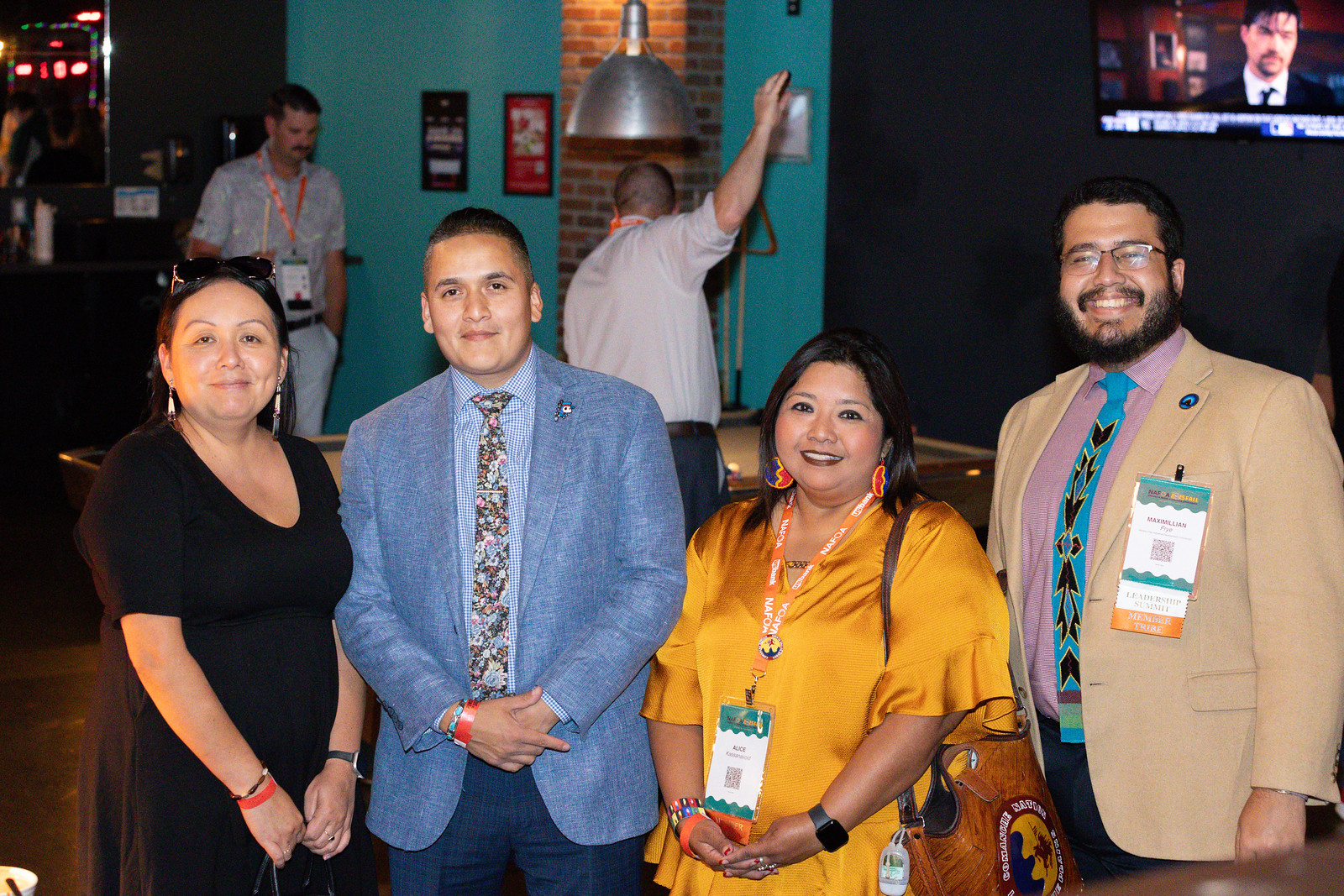
Maximillian T. Frye’s (Leadership Summit ‘25) Commitment to Economic Growth
Maximillian Frye, a citizen of Wichita and Affiliated Tribes and a recent participant of the 2025 NAFOA Leadership Summit, is deeply committed to advancing the economic interests of his community.
While attending the Summit and the Fall Conference, he noted that one of his “…biggest highlights was meeting so many new people, particularly people in higher roles, leading to tangible business conversations for my EDC [economic development commission].”
Frye believes that everything is relational in Tribal economic development and shared that his experiences since participating in the NAFOA Leadership Summit have continued to expand his efforts to support his community.
3. PROFESSIONAL DEVELOPMENT:
One Month Left! Rolling Admissions for Leading People & Investing to Build Sustainable Communities
Applications for NAFOA’s Leading People & Investing to Build Sustainable Communities (LPIBSC) program at Harvard Business School are still being accepted on a rolling basis until January 4, 2026, at 11:59 p.m. HST. Please note that the priority consideration period has ended, and financial assistance is not guaranteed.
LPIBSC is an executive education program developed in partnership with Harvard Business School Executive Education and AFOA Canada. The program brings together Tribal and Indigenous leaders from the United States, Canada, New Zealand, and Australia to foster innovation and build high-performing communities and organizations.
4. MUST READ:
Tribal Casinos: An Economic Boon
American Indians on tribal lands in the United States have historically faced some of the nation’s worst economic conditions.The proportion of American Indian people living below the poverty line in 1989 was 31%, considerably higher than the 13% national poverty rate at the time.
The expansion of Tribal casinos that began in the 1990s helped improve economic conditions faster for American Indians relative to the U.S. population as a whole, according to joint U.S. Census Bureau and university research, though there is still progress to be made: the American Indian poverty rate was 19.6% in 2024, greater than that year’s national average of 12.1%, according to Census Bureau data.
In recent years, the American Indian gaming industry generated more than $40 billion annually.
A working paper, written by Maggie R. Jones (Census Bureau), Randall Akee (Census Bureau and University of California Los Angeles) and Emilia Simeonova (Johns Hopkins University) used census data to evaluate the ZIP-code-level economic impact of tribal casinos on nearby people and places.
Source: United States Census Bureau
5. JOB OPPORTUNITY:
Chief Financial Officer, Confederated Tribes and Bands of the Yakama Nation
The role of CFO oversees all the key components of the finance function such as financial planning, expense management, accounting, grant management, risk assessment, tax compliance, financial-legal regulations, and financial reporting. Responsible for creating and monitoring an airtight legal comprehensive financial manual that includes accounting, payroll, cash management, grant management, and procurement for the optimization of Tribal government operations.