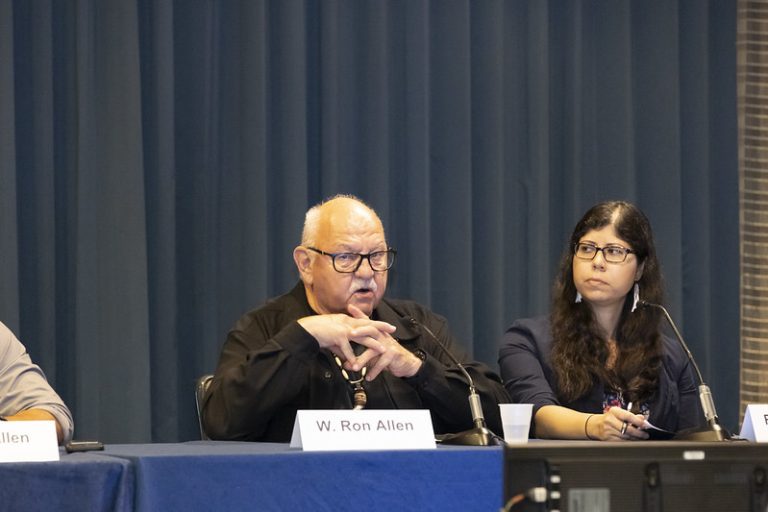
At today’s public meeting of the Treasury Tribal Advisory Committee (TTAC), the Treasury announced the publication of rules on the General Welfare Exclusion Act of 2014 (GWE) and Tribally Chartered Corporate Entities, as well as updates to the Adoption Tax Credit for Tribal Special Needs determinations. The finalization of these rules is the result of close collaboration with Tribes, Tribal leaders, Tribal organizations, and the TTAC, and addresses longstanding questions regarding the clarity and tax certainty necessary for sustainable Tribal economic development.
Along with the support of the Department of the Treasury, members of Congress also celebrated today’s announcements. Senator Catherine Cortez Masto (D-NV) offered commentary, stating, “I’m encouraged to see the Treasury Department take these steps to improve how tax policies affect our Tribes. Clarifying that Tribally chartered businesses are exempt from income taxes and fully implementing the Tribal General Welfare Exclusion Act will help Native communities and encourage economic development. As Nevada’s voice on the Senate Committee on Indian Affairs, I’ll continue to push the Trump Administration to do right by our Tribes.”
General Welfare Exclusion Act of 2014
The finalized GWE rules are a significant step forward for Indian Country. The guidance incorporates feedback from Tribal consultations to ensure it meets Tribal needs and respects cultural sensitivity. In October 2022, the TTAC Subcommittee on General Welfare Exclusion submitted its initial report to the Treasury outlining core principles for the implementation of new GWE rules. The report establishes principles that should govern the creation and implementation of GWE guidance, setting the foundation for today’s announcement.
In accordance with federal Tribal self-determination principles, the GWE guidance acknowledges the sovereign discretion of Tribal governments and their exclusive authority to budget for general welfare benefits and to design, develop, and administer these programs. This authority includes determining program types and benefit levels based on the unique circumstances, needs, customs, culture, traditions, and practices of each Tribal government.
Tribal Wholly-Owned Corporate Entities
The newly announced rules explicitly exempt wholly-owned Tribally Chartered Corporate entities from federal income tax, finally providing the clarity Tribes have demanded for decades. This exemption is a victory for Tribal economic sovereignty and was also secured through sustained Tribal advocacy and meaningful consultation.
Uncertainty about the tax status of wholly-owned Tribally Chartered Corporate entities has significantly impeded Tribal economic growth. This ongoing ambiguity has resulted in tribes facing unfairly high interest rates and financial barriers, despite having called for clear federal guidance for over thirty years.
NAFOA Board President Rodney Butler, Chairman of the Mashantucket Pequot Tribal Nation, commented on the publication of the rules:
“These final rules represent a tremendous step forward for Indian Country. They recognize that Tribes have unique enterprise structures and provide the broad applicability needed to support our diverse economies. Let us be clear: through these Tribal business structures, we are employing millions of Americans and we are not just growing our own economies—we are growing the American economy.”
Key Highlights of the New Regulations
- Tribal Deference
- Refers to Tribal discretion regarding the determination of what constitutes general welfare and cultural significance.
- Acknowledges that Tribes are best positioned to determine the needs of their members.
- Expanded Definition of Eligible Individuals
- Individuals eligible for the Tribal General Welfare Expenditure (GWE) program include:
- Tribal members, spouse of Tribal member, dependent, or other individual who has been determined by the Indian Tribal government to be eligible, such as an ancestor, descendant, former spouse, caregiver, widow or widower, legally recognized domestic partner or former domestic partner.
- Individuals eligible for the Tribal General Welfare Expenditure (GWE) program include:
- No Limitation on Source of Funds
- A general welfare benefit under a Tribe’s program may be funded by any source of revenue, including net gaming revenue.
- Deference to Tribal Revenue Classification
- Tribes may classify revenue as general welfare rather than per capita payments.
- Tribes may amend revenue allocation plans accordingly.
- Uniform Payments and No Needs Testing
- Uniform Payments are permitted.
- No requirement that benefits are based on financial need.
- General Welfare through Grantor Trusts
- Tribes may provide general welfare through grantor trusts.
- Tribes may modify an existing IGRA trust to provide general welfare benefits.
- Economic Development as General Welfare
- Programs may support individuals starting, expanding, or operating businesses.
- Application of Rules to Alaska Native Regional or Village Corporations
- ANCs or villages may choose to apply these rules until specific regulations addressing ANCs are published.
- Audit Suspensions and the Education and Training Requirement of the Internal Revenue Service (IRS) Field Agents
- Audit suspension will not be lifted until the required training of the Internal Revenue Service (IRS) field agents on General Welfare Exclusion (GWE) is completed.
- IRS will consult with TTAC and Tribes to create appropriate and comprehensive training.
- Apply suitable deference to Tribal determinations regarding general welfare and cultural benefits.
“Lavish and Extravagant” Standard:
- Restrictions apply if general welfare benefits reach “lavish and extravagant” standards.
- While the precise definition of “lavish and extravagant” has not been defined in the final rules, the regulations are intentionally structured to provide substantial deference to Tribal authority. Tribes can be assured that, under these rules, their decisions will be respected and given considerable weight.
- This will be addressed during the training of IRS agents.
Rules on Tribal Wholly-Owned Corporate Entities:
Tax Treatment:
- Confirmation on the Federal tax classification of Entities wholly owned by Indian Tribal Governments
- Entities that are wholly owned by Tribes and organized or incorporated under the laws of one or more of the Tribes that own them generally are not recognized as separate entities for Federal tax purposes, and are therefore not subject to federal income tax.
- Coverage of Entity Types
- The rule applies to entities organized as corporations or limited liability companies.
- Limited liability protections concerning federal employment and excise taxes:
- Tribally chartered entities are treated as separate from the tribe for federal employment and excise tax purposes.
- This limits Tribal government liability and reduces administrative burdens, particularly for multi-tribal entities.
- Clarity on indirect ownership and Tiered Structures:
- Wholly owned status may be satisfied through direct or indirect ownership.
- Subsidiaries of wholly owned Tribal entities are not treated as separate taxable entities for federal income tax purposes.
- Tax status of partially owned entities is subject to further consultation
- Treasury committed to separate consultation with Tribes and TTAC before issuing guidance on partially Tribally owned entities.
NAFOA will continue to work with the Administration, Treasury, and the TTAC on the implementation of these new rules and will be hosting a series of webinars on these changes starting in 2026. We look forward to continuing the conversation on ongoing issues such as the tax status of Tribal corporate entities that are partially owned.
Adoption Tax Credit for Tribal Special Needs Determinations
Treasury also announced new rules for the Adoption Tax Credit for Tribal Special Needs determinations, a provision of the Tribal Tax and & Investment Reform Act (S. 2022) included in this summer’s One Big Beautiful Bill. The new rule grants Tribal governments the same authority as State governments to determine whether a child has special needs for the purpose of claiming the Adoption Credit. The new rule establishes eligibility to claim the credit, amounts for the adoption tax credit, updated IRS forms, including Tribal examples to IRS Form 8839 to claim the credit, and documentation flexibility (i.e., allowing a variety of Tribal certifications of special needs, including a letter). These changes come after an expedited consultation period with Tribal members and the TTAC Subcommittee on Parity and Reform.
On behalf of NAFOA’s Board of Directors and Member Tribes, we applaud the work of the staff at the U.S. Department of the Treasury, the Office of Tribal and Native Affairs, the Internal Revenue Service, and the Administration, as well as the Tribal Leaders who serve on the TTAC and their technical advisors for their work on behalf of Indian Country.
If you have any questions or need additional information, contact Nicholas Lovesee, Policy Director at nicholas@nafoa.org, or Marisa Joseph, Policy Specialist, at marisa@nafoa.org.